Moluccas International Campaign for Human Rights

  • THESE ARE THE MOLUCCAN ISLANDS: FACTS & OPINIONS
  • MELANESIA VERSUS INDONESIA
  • ABOUT MOLUCCAS INTERNATIONAL CAMPAIGN FOR HUMAN RIGHTS
  • REPRESSION OF A BASIC HUMAN RIGHT IN MALUKU: FREEDOM OF POLITICAL EXPRESSION
  • TOP STORIES
  • SOUTH MOLUCCAS ISLANDS’ ILLEGAL OCCUPATION BY JAKARTA
  • MOLUCCAS SOVEREIGNTY FRONT - FRONT KEDAULATAN MALUKU (FKM)
  • PHOTOS FKM-RMS DEMONSTRATION IN FRONT OF PARLIAMENT HOUSE OF ADELAIDE, AUSTRALIA ON OCTOBER 26, 2010 & SEPTEMBER 7, 2010
  • PROKLAMASI NEGARA REPUBLIK MALUKU SELATAN (RMS)
  • INDONESIA = REPUBLIK MALING & KEBOHONGAN REZIM SBY
    • MAFIA HUKUM INDONESIA - JUDICIAL MAFIA
    • CORRUPTION - POVERTY & UNDERDEVELOPMENT IN THE MOLUCCAS – KORUPSI - KEMISKINAN DAN KETERBELAKANGAN DI MALUKU
    • LATEST NEWS FEBRUARY 2012
    • BREAKING NEWS MOLUCCAS
    • BERITA2 MALUKU
    • SUSILO BAMBANG YUDHOYONO AND HIS GENERALS
    • INDONESIAN MILITARY INVOLVEMENT WITH AGGRESSIVE MINING, ILLEGAL LOGGING AND ILLEGAL FISHING IN THE MOLUCCAS
    • LASKAR JIHAD - SUHARTO COMPANIONS AND THE MOLUCCAN CIVIL WAR - JUSTICE DEMAND
    • MOLUCCAS: GENOCIDE ON THE SLY – INDONESIA’S TRANSMIGRATION AND ISLAMISATION PROGRAM
    • OUR CAMPAIGN & CONTACT MICHR
    • ECOLOGY & SUSTAINABLE DEVELOPMENT IN THE MOLUCCAS
    • DISPLACED PEOPLE IN THE MOLUCCAS - PENGUNGSI DI MALUKU
    • INSIDE INDONESIA’S WAR ON TERROR
    • TNI, BRIMOB AND STATE TERROR IN THE MOLUCCAS
    • IMPUNITY AND THE INDONESIAN MASTERS OF TERROR
    • 60 YEARS OF HUMAN RIGHTS AND A PETITION TO PRESIDENT-ELECT BARACK OBAMA
    • 100 YEARS of INTERNATIONAL WOMEN’S DAY
    • 26 June - UN INTERNATIONAL DAY in SUPPORT of VICTIMS of TORTURE
    • 9 August - UN INTERNATIONAL DAY OF THE WORLD’S INDIGENOUS PEOPLES
    • GUESTBOOK - FEEDBACK
    • THE DUTCH - INDONESIA CORPORATE CONNECTION
    • LIBERATING OUR COLONIAL MINDSET
    • UNPO 2009 CAMPAIGN: EARTH, EXPLOITATION AND SURVIVAL
    • IFET & ETAN LETTERS TO UN SECURITY COUNCIL AND HILLARY CLINTON
    • INDONESIA: 10 YEARS AFTER 'REFORMASI'
    • INDONESIA after 64 YEARS of 'INDEPENDENCE' STILL NOT A BETTER PLACE
    • Pemilihan Umum Kepala Daerah (Pemilukada) Maluku 9 Juli 2008
    • PERNYATAAN TERBUKA KEPADA SAMUA BASUDARA BANGSA MALUKU/ALIF’URU/INA YANG BERADA DI NEGERI BELANDA, DI TANAH AIR MALUKU SELATAN, BAHKAN DISELURUH DUNIA

    MELANESIA AND INDONESIA

    MELANESIA Versus INDONESIA

    by Bernard Nietschmann 
      
    Consider that there are two major forces in collision worldwide: 
      
    the expansion of states and the defending nations. Indonesia and Melanesia - two
    large geographic areas of islands -represent these counterpoised forces of
    political incorporation by invasion, and political liberation by
    self-determination. Indonesia is a new colonial state built on Javanese
    expansion by armies and settlers against the peoples of Sumatra, Kalimantan,
    South Moluccas, East Timor, and West Papua. Melanesia is an equally large area
    that has an emerging geopolitical identity based on independence from colonial
    occupation. Indonesia is an archipelago of different nations united by force;
    Melanesia is an archipelago of similar peoples united by choice. 
     
     
    Independence from colonial rule is spreading throughout Melanesia: Fiji (1970), Papua New
    Guinea (1975), Solomon Islands (1978), Vanuatu (1980), and Kanaki (New Caledonia
    claimed by France) will achieve independence in the near future. That leaves the
    Torres Strait Islands (claimed Australia), and West Papua, South Moluccas and
    East Timor (claimed by Indonesia). 

    Melanesia has a very strong internal affinity based on identity and a growing consensus
    against non-Melanesian control by occupation. Vanuatu is in the forefront of the
    pan-Melanesian movement. In an address to the United Nations General Assembly
    (October 11, 1984), Vanuatu Foreign Minister Sela Molisa stated: 
     
    We regret that there is some justification to the Israeli and South African
    complaint that the international community is very selective in its
    denunciations. It pains us deeply that there is indeed a grain of truth to this
    argument. How else can we explain the condemnations of the annexation of
    Jerusalem and the Golan Heights, but silence on the annexation of East Timor?
    How else can we explain the condemnations of apartheid but the silence on the
    plight of the Melanesian people of West Papua? 

    How else can we explain the appeals to sever economic ties with South Africa while a
    South African company participates in the exploitation of West Papua's oil
    resources? How else can we explain the concern over Israeli and South African
    military expansionism, and the indifference to the military expansionism in our
    region which has already seen West Papua and East Timor swallowed, if not
    digested, and which now provokes, and threatens the sovereignty and territorial
    integrity of our good neighbor, Papua New Guinea?

    Our region is known for its calm and serene atmosphere. The countries of the South
    Pacific are populated by peace loving people of diverse ethnic and cultural
    backgrounds. However, our similar colonial histories have instilled in us all a
    strong aversion to external interference and foreign rule. On this we are in
    total accord.

    Unfortunately, the international community has not yet taken note of this. Thus, while our
    support is given as a matter of principle in the struggle against apartheid,
    little is known of our own struggle against the same practices in our own
    region. Molisa, October 11, 1984


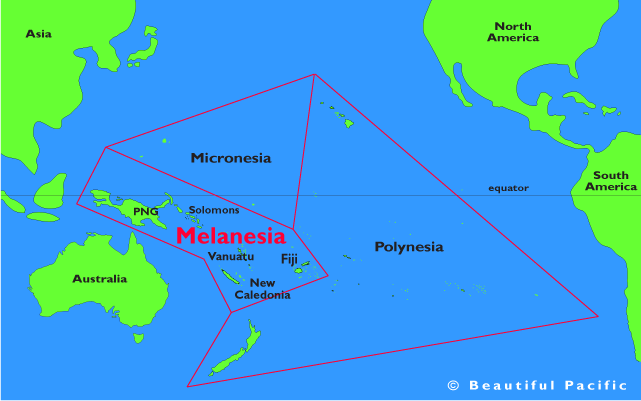
    Melanesia (from Greek: μέλας black, νῆσος island) literal meaning is "islands of the black-skinned people".
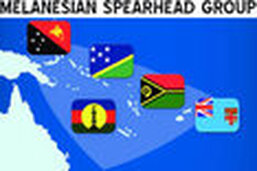
    Melanesia is a subregion of Oceania extending from the western side of the West Pacificto the Arafura Sea, north and northeast of Australia. The term was first used by Jules Dumont d'Urville in 1832 to denote an ethnic and geographical grouping of islands distinct from Polynesiaand Micronesia.Today, d'Urville's racial classification is regarded to be inaccurate because it ignores the broad cultural, linguistic, social and genetic diversity in the area. There is no one 'Melanesian culture' or way of life. However, there is a widely used geopolitical conception of the term 'Melanesia'. For example, the Melanesian Spearhead Group Preferential Trade Agreement is a regional trade treaty governing the states of Vanuatu, Solomon Islands, Papua New Guinea, and Fiji. Melanesia is also current as a geographic term, used as a reference to the area when national, ethnic, and linguistic distinctions are not relevant.

    People
    The original inhabitants of the islands now named Melanesia were likely the ancestors of the present day Papuan-speaking people. These people are thought to have occupied New Guinea tens of millennia ago and reached the islands 35,000 years ago (according to radiocarbon dating). They appear to have occupied these islands as far east as the main islands in the Solomon Islands (i.e., including San Cristobal) and perhaps even to the smaller islands farther to the east.It was particularly along the north coast of New Guinea and in the islands north and east of New Guinea that the Austronesian people came into contact with these pre-existing populations of Papuan-speaking peoples, probably around 4000 years ago. There was probably a long period of interaction that resulted in many complex changes in genetics, languages, and culture. It is likely that from this area a very small group of people (speaking an Austronesian language) departed to the east to become the forebears of the Polynesian people. This finding is, however, contradicted by a study published by Temple University finding that Polynesians and Micronesians have little genetic relation to Melanesians; instead they found significant diversity of between groups living within the Melanesian islands. (*) Genome scan shows Polynesians have little genetic relationship to Melanesians.

    HIRA I NI ENTUB FO I NI, IT DID ENTUB FO IT DID. – A PERSON’S PROPERTY SHALL REMAIN THAT PERSON’S PROPERTY, OUR PROPERTY REMAINS OUR OWN.