Moluccas International Campaign for Human Rights

  • THESE ARE THE MOLUCCAN ISLANDS: FACTS & OPINIONS
  • MELANESIA VERSUS INDONESIA
  • ABOUT MOLUCCAS INTERNATIONAL CAMPAIGN FOR HUMAN RIGHTS
  • REPRESSION OF A BASIC HUMAN RIGHT IN MALUKU: FREEDOM OF POLITICAL EXPRESSION
  • TOP STORIES
  • SOUTH MOLUCCAS ISLANDS’ ILLEGAL OCCUPATION BY JAKARTA
  • MOLUCCAS SOVEREIGNTY FRONT - FRONT KEDAULATAN MALUKU (FKM)
  • PHOTOS FKM-RMS DEMONSTRATION IN FRONT OF PARLIAMENT HOUSE OF ADELAIDE, AUSTRALIA ON OCTOBER 26, 2010 & SEPTEMBER 7, 2010
  • PROKLAMASI NEGARA REPUBLIK MALUKU SELATAN (RMS)
  • INDONESIA = REPUBLIK MALING & KEBOHONGAN REZIM SBY
    • MAFIA HUKUM INDONESIA - JUDICIAL MAFIA
    • CORRUPTION - POVERTY & UNDERDEVELOPMENT IN THE MOLUCCAS – KORUPSI - KEMISKINAN DAN KETERBELAKANGAN DI MALUKU
    • LATEST NEWS FEBRUARY 2012
    • BREAKING NEWS MOLUCCAS
    • BERITA2 MALUKU
    • SUSILO BAMBANG YUDHOYONO AND HIS GENERALS
    • INDONESIAN MILITARY INVOLVEMENT WITH AGGRESSIVE MINING, ILLEGAL LOGGING AND ILLEGAL FISHING IN THE MOLUCCAS
    • LASKAR JIHAD - SUHARTO COMPANIONS AND THE MOLUCCAN CIVIL WAR - JUSTICE DEMAND
    • MOLUCCAS: GENOCIDE ON THE SLY – INDONESIA’S TRANSMIGRATION AND ISLAMISATION PROGRAM
    • OUR CAMPAIGN & CONTACT MICHR
    • ECOLOGY & SUSTAINABLE DEVELOPMENT IN THE MOLUCCAS
    • DISPLACED PEOPLE IN THE MOLUCCAS - PENGUNGSI DI MALUKU
    • INSIDE INDONESIA’S WAR ON TERROR
    • TNI, BRIMOB AND STATE TERROR IN THE MOLUCCAS

    • IMPUNITY AND THE INDONESIAN MASTERS OF TERROR
    • 60 YEARS OF HUMAN RIGHTS AND A PETITION TO PRESIDENT-ELECT BARACK OBAMA
    • 100 YEARS of INTERNATIONAL WOMEN’S DAY
    • 26 June - UN INTERNATIONAL DAY in SUPPORT of VICTIMS of TORTURE
    • 9 August - UN INTERNATIONAL DAY OF THE WORLD’S INDIGENOUS PEOPLES
    • GUESTBOOK - FEEDBACK
    • THE DUTCH - INDONESIA CORPORATE CONNECTION
    • LIBERATING OUR COLONIAL MINDSET
    • UNPO 2009 CAMPAIGN: EARTH, EXPLOITATION AND SURVIVAL
    • IFET & ETAN LETTERS TO UN SECURITY COUNCIL AND HILLARY CLINTON
    • INDONESIA: 10 YEARS AFTER 'REFORMASI'
    • INDONESIA after 64 YEARS of 'INDEPENDENCE' STILL NOT A BETTER PLACE
    • Pemilihan Umum Kepala Daerah (Pemilukada) Maluku 9 Juli 2008
    • PERNYATAAN TERBUKA KEPADA SAMUA BASUDARA BANGSA MALUKU/ALIF’URU/INA YANG BERADA DI NEGERI BELANDA, DI TANAH AIR MALUKU SELATAN, BAHKAN DISELURUH DUNIA

    TNI, BRIMOB AND STATE TERROR IN THE MOLUCCAS

    “After Suharto stepped down in 1998, I was given the order to establish a paramilitary unit ...” ~Kivlan Zen, former Indonesian Army chief of staff - GlobalPost – International News September 5, 2011.
    Partners in crime
    Sydney Morning Herald November 2, 2002

    They are our new allies in the war against terrorism. But Indonesia's military and security agencies seem more intent on fighting each other for economic spoils than tracking down extremists. Hamish McDonald and Matthew Moore report.


    Early this week, a military attache with a Western embassy in Jakarta was given a tip-off by senior officers in Indonesian armed forces headquarters: the head of the counter-terrorism unit with the Indonesian army's special forces had been identified as a source of the explosives used in the October 12 bombings in Bali.

    The attache and other defence analysts quickly identified what this was all about: discrediting the father-in-law of the officer mentioned, who happens to be retired general A.M. Hendropriyono, the head of the state intelligence agency, or BIN, which is eclipsing the military role in anti-terrorism.

    That such a transparent piece of disinformation could be attempted at relatively high levels of the military - and be met with a ho-hum reaction by its recipients - testifies to an astonishing level of credulity here about what agencies of the state are capable of doing.

    One conspiracy theory after another has hit the media or circulated around the Jakarta elite this week.

    One front-page story had two prominent generals as masterminds of the Bali bombings. Another theory pointed to former defence minister General Wiranto. On Wednesday, US ambassador Ralph Boyce had to fend off renewed questioning from local reporters suggesting the CIA had a hand in the attack.

    On Thursday, newspapers quoted police chief General Da'i Bachtiar raising suspicions about separatists in remote Aceh province.

    Way down the list of suspects, it seems, are the organisations that Western governments most strongly suspect: Osama bin Laden's al-Qaeda terrorist group from the Middle East, and Jemaah Islamiah, a similar-minded local group of radical Islamists who aspire to create a pan-Islamic state including all believers in South-East Asia.

    Indonesians don't know much about these two groups. The first is remote from their experience, the second a fringe group with outlandish ideas. But Indonesians do know about their own military, police and intelligence agencies, which is why these conspiracy theories fly.

    Over decades, Indonesians have seen their security agencies stage all kinds of provocations and fake terrorist incidents for political ends. They also know them to be deeply corrupt.

    The country has opened up immensely since the 1998 fall of former president Soeharto, whose authoritarian rule has been replaced by election-based politics. But the security forces remain their own masters and, in the eyes of many critics, continue to foment violent outbreaks and exacerbate crises around Indonesia to justify their special role.

    The armed forces, or TNI (Tentara Nasional Indonesia), still largely fund themselves from a mix of legal and illegal business activities that raise an estimated $6.4 billion a year, as against their funding from the Government budget of only $3.2 billion. TNI-controlled "charitable foundations" run 64 companies in everything from shopping centres to airlines to logging, while the army, navy and air force have their own empires. But by far the most lucrative are protection payments paid by private enterprises, from huge resource companies down to criminals behind gambling, drugs and prostitution.

    This wasn't such a security problem until Soeharto's fall. Since then, the military's grip on its cash flow has been challenged from other quarters.

    The police, previously run as the fourth branch of the armed forces, were taken out of the Defence Department and put under civilian control two years ago. While the military have been left with their network of domestic garrisons known as the Territorial Command structure, a new law also gives the police responsibility for internal security - without extra funding or resources.

    Another major change has been the devolution of political authority from Jakarta to the 30 provinces and 400 local governments, which have gained direct access to much of the tax revenue from mining and timber. Alongside the power and funds, corruption and extortion have also been decentralised.

    The result is that police and army units are now fighting for control of protection rackets and other sources of income across the country.

    Last month, at Binjai in North Sumatra, an army airborne unit tied up its officers and attacked two local police stations using rocket-propelled grenades and automatic weapons, killing eight police and civilians, in a squabble over 1.5 tonnes of cannabis. On the eastern island of Flores, police and the army have battled repeatedly in the streets of the main city, Maumere. Protection money has emerged as a possible motive for the attack on 10 teachers at the American-owned Freeport Mine in Papua in August, in which two Americans and one Indonesian died.

    According to Marcus Mietzner, a German scholar researching the Indonesian military for a doctorate at the Australian National University, some companies are paying protection money to as many as 14 groups, including army, police, ethnic militias and the "security units" or Satgas attached to political parties.                                                                                           
    Picture
    101 East looks at the human rights record of Indonesia's anti-terror police unit BRIMOB


    • Suharto son-in-law says military 'capable' of creating unrest
    • Wiranto fans Ambon's flames By  George Junus Aditjondro
    • Army accused over Moluccas conflict
    • TNI accused of imposing martial law 'by stealth' in Maluku

    Picture
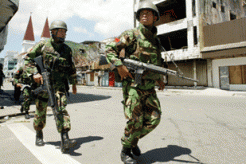
    Indonesia maintains a strong military presence in  Maluku –
    Aljazeera 2008-04-04

    • Army 'runs Indonesia'
    • Analysis: Community-based military surveillance returns to Indonesia
      By Dr. Jim Schiller
    • New Violence in Indonesia's Ambon
      By International Crises Group

    George Aditjondro- "TNI is still present in places where big investments exist and we can still see a link between investment and military interests."

    Picture
    The armed forces continue to foment violent outbreaks and exacerbate crises around Indonesia to justify their special role.


    HIRA I NI ENTUB FO I NI, IT DID ENTUB FO IT DID. – A PERSON’S PROPERTY SHALL REMAIN THAT PERSON’S PROPERTY, OUR PROPERTY REMAINS OUR OWN.